
OEM Private Label Guide
Hidden Risks When Choosing a Sports Tape Manufacturer
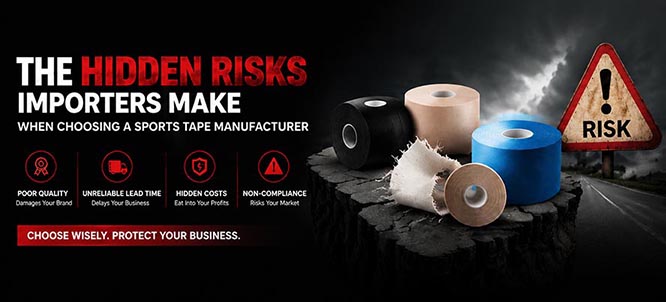
In the global sports medicine industry, selecting a sports tape manufacturer is not a simple procurement task—it is a long-term brand risk decision that directly affects product performance, compliance safety, and market competitiveness.
Many importers searching for kinesiology tape OEM suppliers or private label sports tape manufacturers focus primarily on pricing. However, the real cost of sourcing mistakes often appears later in the form of inconsistent quality, shipment delays, or failed retail approvals.
This guide breaks down the hidden risks importers face and provides a structured framework to help you choose a reliable sports tape factory for long-term business growth.
1. Quality Inconsistency Across Production Batches (Core Risk)
Batch instability is the most damaging issue in sports tape sourcing.
Even when samples are approved, mass production may vary due to:
- Adhesive coating thickness variation
- Fabric tension inconsistency
- Elastic recovery deviation
- Moisture resistance fluctuation
Industry Standard Testing Metrics:
- ASTM D3330 Peel Adhesion Test
- Elastic elongation stability range (120%–180%)
- Skin compatibility testing for medical-grade adhesives
- Humidity resistance simulation testing
A reliable sports tape manufacturer must implement full batch traceability and inline quality control systems.
2. OEM and Private Label Misrepresentation
Many suppliers claim to offer OEM sports tape and private label services, but lack real production capability.
Common limitations:
- No in-house packaging design system
- Weak logo printing accuracy
- No Pantone color control system
- High MOQ without flexibility
- Limited SKU customization capability
A true private label sports tape OEM should support:
- End-to-end packaging customization
- Retail-ready product development
- Brand identity consistency across SKUs
3. Compliance Risks (ISO 13485 / EU / FDA Awareness)
Compliance failure is a hidden but critical risk in global sports tape sourcing.
Key requirements include:
- ISO 13485 medical device quality system
- EU REACH compliance for adhesive materials
- MSDS documentation for export clearance
- Biocompatibility testing for skin-contact materials
Failure in compliance may result in:
- Customs delays
- Retail rejection
- Market entry restrictions
4. Supply Chain Instability in Peak Seasons
Sports tape demand is highly seasonal, especially in:
- Sports tournaments
- Physiotherapy rehabilitation cycles
- Fitness industry promotions
Risks include:
- Raw material shortages
- Production line overload
- Shipping delays
- Inaccurate forecasting
A stable sports tape supplier maintains:
- Multi-source material procurement
- Reserved OEM production capacity
- Export logistics coordination systems
5. Hidden Cost Structures in Low-Price Offers
Low unit pricing often hides additional costs such as:
- Printing plate charges
- Packaging redesign fees
- Custom color adjustments
- Export documentation costs
This leads to “low quote → high landed cost” problems.
A transparent sports tape manufacturer should provide:
- Full cost breakdown
- MOQ-based pricing tiers
- No hidden customization fees
6. Lack of Application-Based Product Knowledge
Different use cases require different tape performance:
- Physiotherapy Clinics
- Skin-safe adhesive
- Long wear comfort
- Hypoallergenic formulation
- Sports Teams
- High sweat resistance
- Strong dynamic fixation
- Durable elasticity
- Retail Brands
- Strong visual identity
- SKU differentiation
- Packaging competitiveness
Manufacturers without application knowledge often deliver non-optimized products.
7. Weak Communication and Project Management
Cross-border sourcing failures often come from communication gaps:
- Delayed sampling feedback
- Misunderstood artwork revisions
- Lack of production transparency
- No structured reporting system
Professional OEM factories use:
- Dedicated account managers
- Visual approval workflows
- Weekly production updates
8. Weak Market Positioning Capability
Modern buyers expect manufacturers to understand:
- Amazon retail positioning
- Distributor market segmentation
- Physiotherapy vs sports retail differences
- SKU strategy by region
Without this, products become technically correct but commercially weak.
9. Weak After-Sales Support System
Common issues:
- No defect tracking system
- Slow complaint response
- No root cause analysis
- No compensation framework
Strong manufacturers provide:
- Batch traceability
- Quality feedback loops
- Replacement policies
10. How to Choose a Reliable Sports Tape Manufacturer (Checklist)
- Manufacturing Capability
- In-house coating and lamination
- Stable production lines
- Batch consistency control
- Quality System
- ISO 13485 certification
- Adhesion testing reports
- Biocompatibility testing
- OEM Capability
- Private label support
- Packaging customization
- SKU development flexibility
- Supply Chain Stability
- Raw material sourcing system
- Export logistics experience
- Production capacity planning
You May Also Like:
FAQ
-
What is the most important factor when choosing a sports tape manufacturer?Quality consistency and ISO-certified production systems are the most critical factors for long-term reliability.
-
How do I know if a sports tape supplier is reliable?Check OEM capability, compliance certifications, production stability, and batch testing reports.
-
What certifications should a kinesiology tape factory have?ISO 13485, REACH compliance, and biocompatibility testing are essential for international markets.
-
What is private label sports tape?Private label sports tape allows distributors to sell tape under their own brand with custom packaging and branding.
-
Why do sports tape shipments get delayed?Common reasons include raw material shortages, peak season overload, and poor production planning.
Related Products for Sports Medicine Applications
- Cohesive bandage – Self-adherent support for joint and muscle compression
- Kinesiology tape – Elastic therapeutic tape for muscle support and recovery
- Zinc oxide tape – Rigid strapping tape for sports injury stabilization
- Rigid sport tape – High-strength fixation for professional athletic use
- Foam underwrap – Skin protection layer for taping applications
- Sports recovery products – Complete solutions for post-training recovery
Get OEM Catalog or Request a Free Sample for Your Market